
Bridging the Gap: Implementing 2D Population Balance Models for Crystal Attrition in engicloud.ai
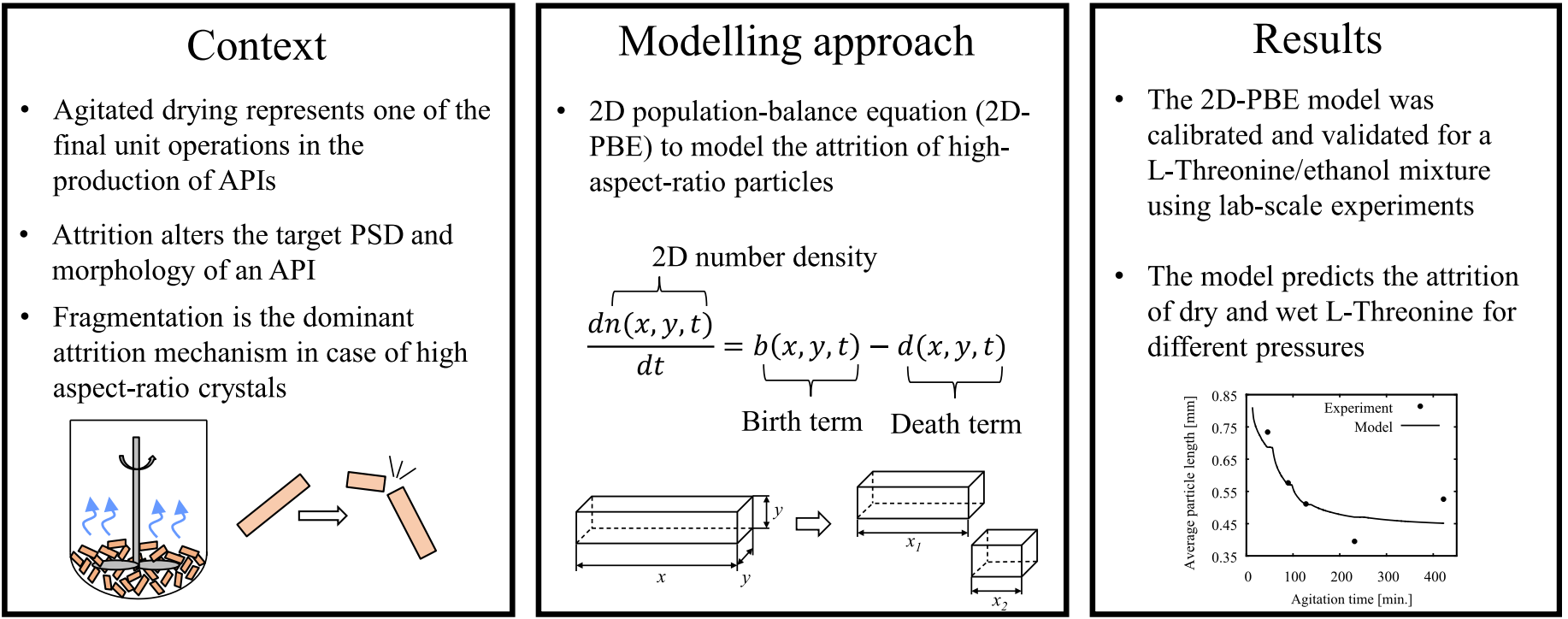
Here is a technically detailed blog post drafted for the engicloud.ai community, focusing on the scientific methodology and the value of executable research.
Bridging the Gap: Implementing 2D Population Balance Models for Crystal Attrition in engicloud.ai
Wanna jump straight to trying it out on the platform?
The full curated project can be found here.
From Static PDF to Executable Code: A Case Study with the Enabling Technologies Consortium (ETC)
In the field of particulate engineering, a recurring challenge is the "implementation gap." Significant research is published, validated, and peer-reviewed, yet the complex mathematical models derived from this work often remain locked in static PDF format. Engineers wishing to utilize these models face the time-consuming task of re-coding algorithms, verifying numerical solvers, and debugging logic before they can run a single simulation.
At engicloud.ai, our mission is to conserve and activate this scientific wisdom. By transforming static publications into Python-based "Calculators," we ensure that high-level physics models are immediately accessible for verification, execution, and recombination.
A prime example of this workflow is our recent implementation of a Two-Dimensional Population Balance Model (2D-PBE) for pharmaceutical drying, developed in collaboration with members of the Enabling Technologies Consortium (ETC), including Bristol Myers Squibb, AstraZeneca, GSK, Genentech, Merck, and Pfizer.
Read the full publication here:
https://doi.org/10.1016/j.powtec.2025.121198
Riccardo Togni, Eric M. Saurer, William Hicks, Pari Rao, Lady Mae Alabanza, Peter Clements, Andrew DiPietro, Lotfi Derdour, Joshua Engstrom, Clara Hartmanshenn, Saivenkataraman Jayaraman, Owen Jones-Salkey, David J. Lamberto, Jason Mustakis, Gqwetha Ncube, Christoph Kloss, A two-dimensional population balance model for predicting the attrition of elongated particles during agitated drying, Powder Technology, Volume 464, 2025, 121198, ISSN 0032-5910,
Read more about how the PBM model was informed with 3D simulation data using the Discrete Element Mehtod (DEM) in our other blog post here.
The Industrial Motivation: Morphology Preservation in API Drying
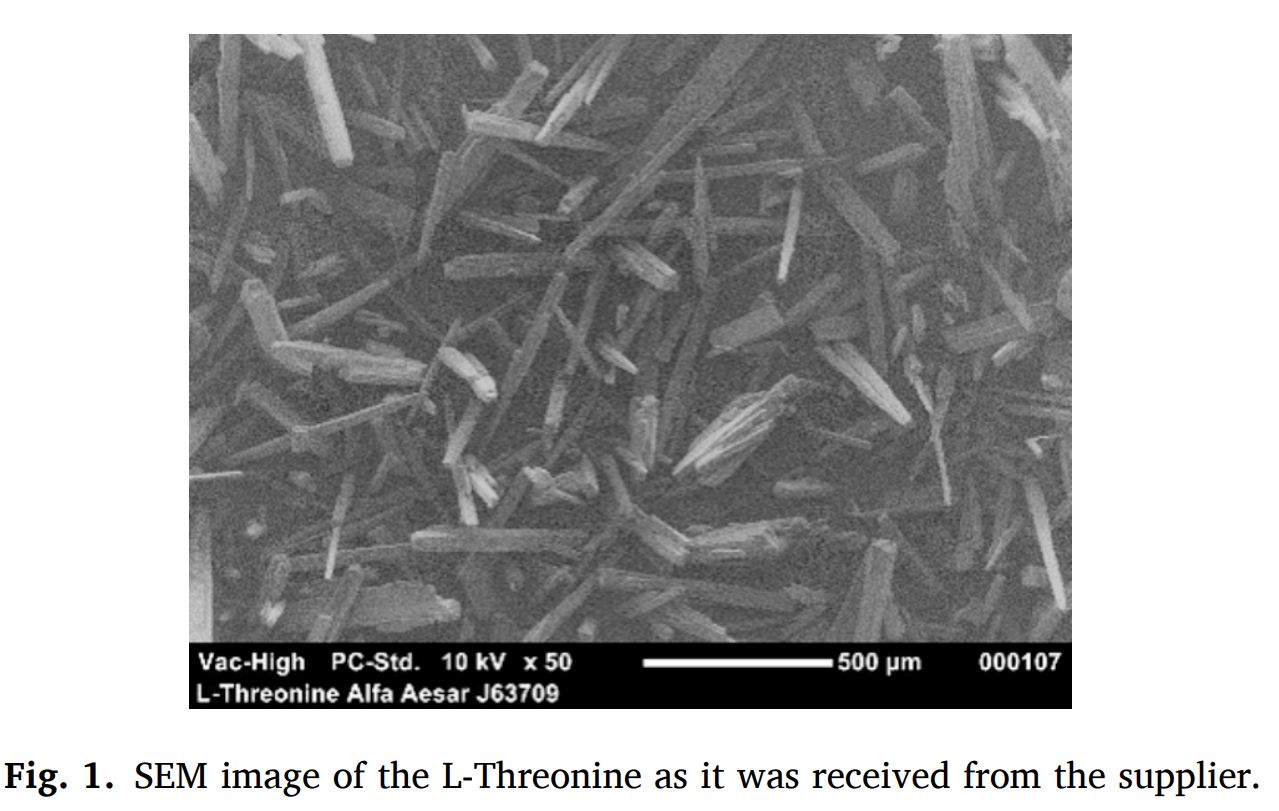
The agitated drying of Active Pharmaceutical Ingredients (APIs) is a critical unit operation. However, it presents a substantial risk to product quality, particularly for materials with high aspect ratios (needle-shaped crystals). During the drying process, the mechanical energy imparted by the agitator causes particle-particle and particle-impeller collisions, leading to attrition (breakage).
For needle-like crystals, this attrition is not uniform. Crystals tend to fracture perpendicular to their major axis, significantly altering the Particle Size Distribution (PSD) and aspect ratio. This morphological change has downstream consequences:
- Filtration & Flow: Reduced particle size can clog filters and impede powder flow.
- Dissolution: Changes in surface area directly impact bioavailability.
- bulk Density: Altered packing arrangements affect dosage and packaging.
The industry required a predictive tool that could correlate process parameters (like agitation speed and torque) with specific attrition rates for non-spherical particles, allowing for "digital scale-up" before physical trials.
The Scientific Challenge: Moving Beyond 1D Models
Standard Population Balance Equations (PBEs) are typically one-dimensional, assuming particles are spheres characterized by a single length scale (diameter). These 1D models fail to capture the physics of elongated crystals, where breakage is a function of both length ($L_1$) and width ($L_2$).
To address this, the research team developed a 2D-PBE framework. This model tracks the evolution of a number density function $n(L_1, L_2, t)$, allowing for the simultaneous prediction of changes in length and width.
Governing Equations implemented in engicloud.ai
The core of the calculator implemented on engicloud is the discretization of the 2D PBE. The rate of change of the particle number density is governed by birth and death terms due to breakage:
$$\frac{\partial n(L_1, L_2, t)}{\partial t} = B(L_1, L_2, t) - D(L_1, L_2, t)$$
Where $B$ represents the birth of new particles from the breakage of larger ones, and $D$ represents the death of particles breaking into smaller fragments.
The critical innovation in this work is the Selection Function ($S$), which describes the specific rate of breakage. The model posits that breakage probability increases with the particle's aspect ratio ($r = L_1/L_2$) and the energy input. The selection function is defined as:
$$S(L_1, L_2) = K_{att} \cdot \dot{\gamma}_{avg} \cdot L_1^2 \cdot g(r)$$
Here, $K_{att}$ is an attrition rate constant derived from material properties, and $\dot{\gamma}_{avg}$ represents the average shear rate. However, because shear rate is difficult to measure directly in industrial dryers, the model correlates the selection function directly to the measurable impeller torque ($T$):
$$S(L_1, L_2) \propto T \cdot L_1^2 \cdot (r - 1)^m$$
This formulation allows the model to predict that long, thin needles ($r \gg 1$) will break significantly faster than short, stout crystals, a physical reality that 1D models miss entirely.
Verification and Results
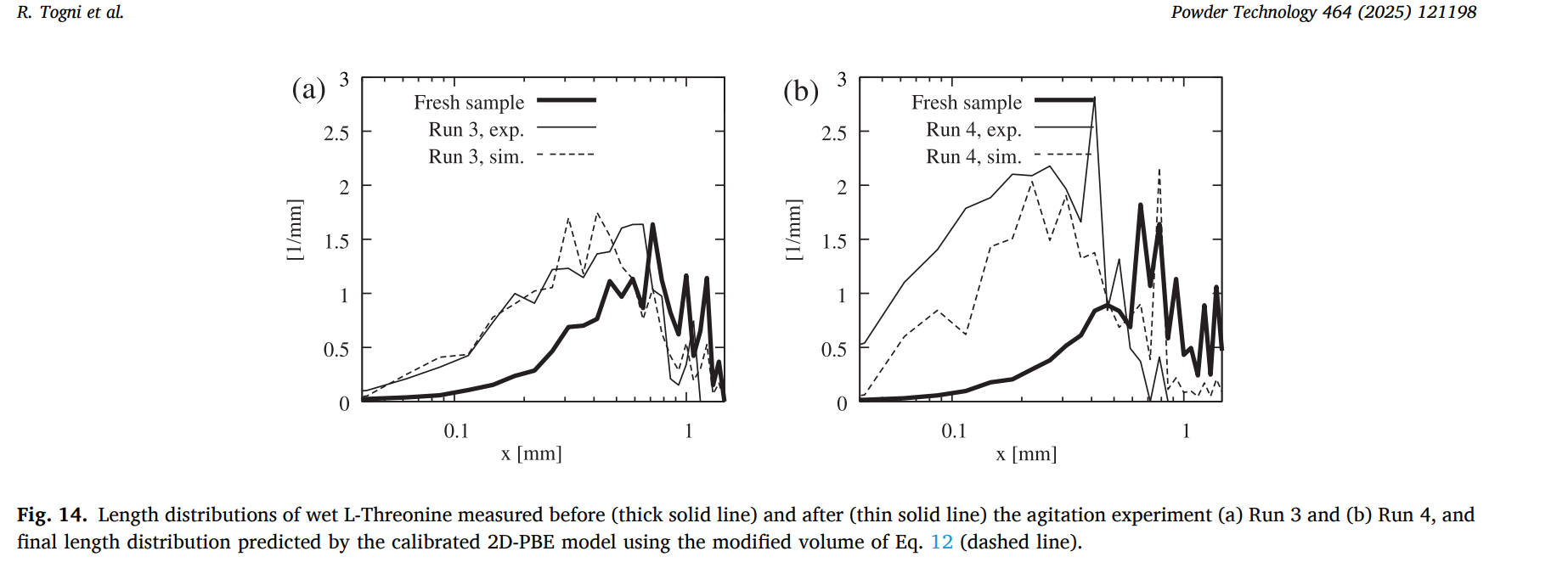
The model was validated using L-Threonine, a material known for forming needle-like crystals. Experiments were conducted in a filter dryer, and the results demonstrated a strong correlation between the simulated PSD and experimental data.
The model successfully captured the "snapping" mechanism, where the length of the crystals reduced drastically over time while the width remained relatively constant, proving the efficacy of the 2D approach.
The engicloud.ai Advantage: Executable Knowledge
Implementing this complex 2D-PBE logic requires sophisticated numerical schemes to solve the coupled differential equations. In a traditional workflow, a researcher reading the paper would have to spend weeks implementing the discretization scheme in MATLAB or Python.
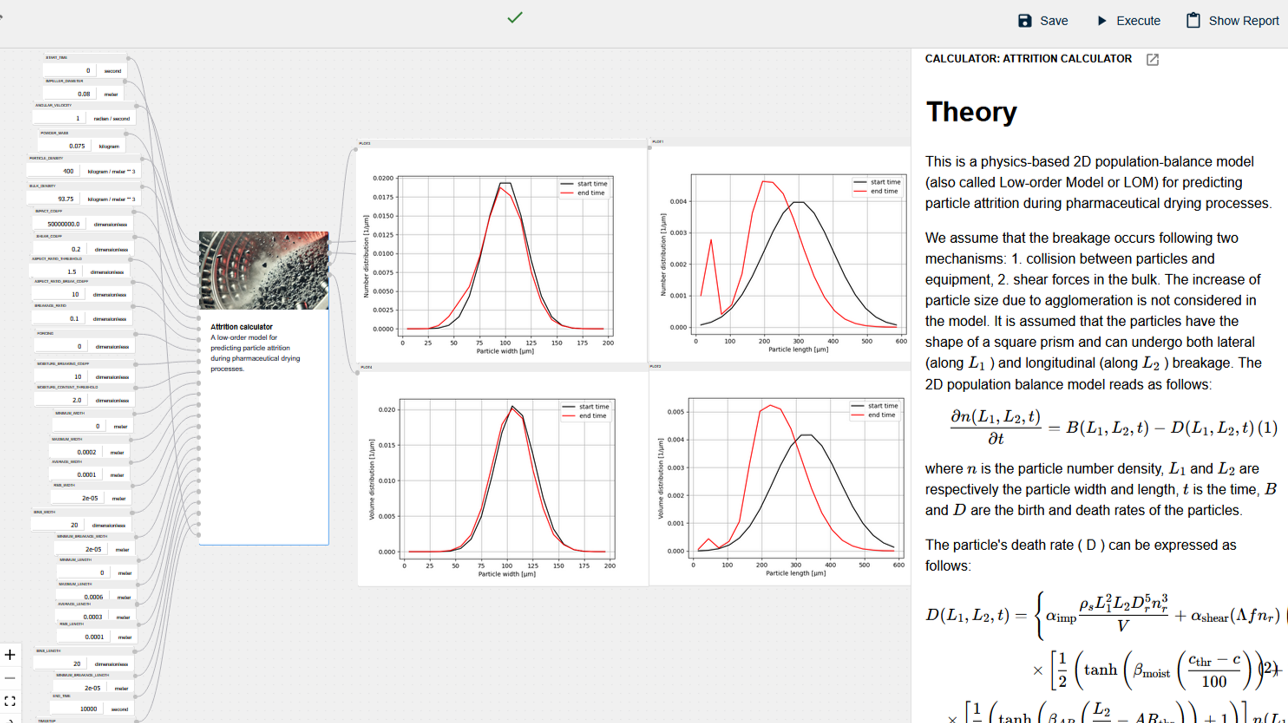
On engicloud.ai, this model exists as a pre-verified Calculator.
- Immediate Execution: Users can input their material parameters (derived from shear cells) and process conditions (Torque/RPM) to generate PSD predictions instantly.
- Workflow Integration: This calculator can be connected to other unit operation models. For example, the output of a crystallization model can be fed directly into this drying attrition model to predict final product quality.
- Transparency: While the calculator is easy to use via the GUI, the underlying Python code and documentation are accessible, ensuring that the "black box" remains transparent for scientific scrutiny.
By hosting this model, we do not just archive the text of the research; we archive the physics itself. This allows teams to collaborate across disciplines—process engineers can run the simulations without needing deep expertise in numerical methods, while R&D scientists can focus on refining the breakage kernels.
Try it out
The full curated project can be found here.
Read the full publication here:
Riccardo Togni, Eric M. Saurer, William Hicks, Pari Rao, Lady Mae Alabanza, Peter Clements, Andrew DiPietro, Lotfi Derdour, Joshua Engstrom, Clara Hartmanshenn, Saivenkataraman Jayaraman, Owen Jones-Salkey, David J. Lamberto, Jason Mustakis, Gqwetha Ncube, Christoph Kloss,
A two-dimensional population balance model for predicting the attrition of elongated particles during agitated drying, Powder Technology, Volume 464, 2025, 121198, ISSN 0032-5910
https://doi.org/10.1016/j.powtec.2025.121198
About the authors
Dr. Riccardo Togni holds a Bachelor and Master of Science degree in Aerospace Engineering as well as a PhD in Computational Fluid Dynamics from University of Bologna. He worked as senior software developer at Jacobs, Swindow (UK) before joining DCS Computing where he is a senior project manager and consultant with deep specialization in powder flow and pharmaceutical process optimization.
Dr. Christoph Kloss is co-founder and director of DCS Computing. He is the original author of the LIGGGGHTS open source and the Aspherix Discrete Element Method (DEM) software. He holds a PhD in fluid mechanics from JKU Linz, has been involved in dozens of consultancy, software development and R&D projects.