
From Model to Canvas: Democratizing Machine Learning Workflows with engicloud.ai
Bridging the ML Deployment Gap: From Repository to Real-World Impact
You’ve trained the model. The accuracy is high, the predictions are validated, and everything is neatly versioned in MLflow. On paper, the project is a success.
But in reality, this is where many Machine Learning projects stall. There is a fundamental "language barrier" in technical organizations: Data scientists speak Python, domain experts speak their field, and executives speak ROI. And somewhere in between, your perfectly good model sits in a repository, waiting for someone to build an interface, deploy an API, and maintain a system that nobody fully owns. engicloud.ai closes this gap by providing the "last mile" of deployment.
One Model, Many Users - A Use Case
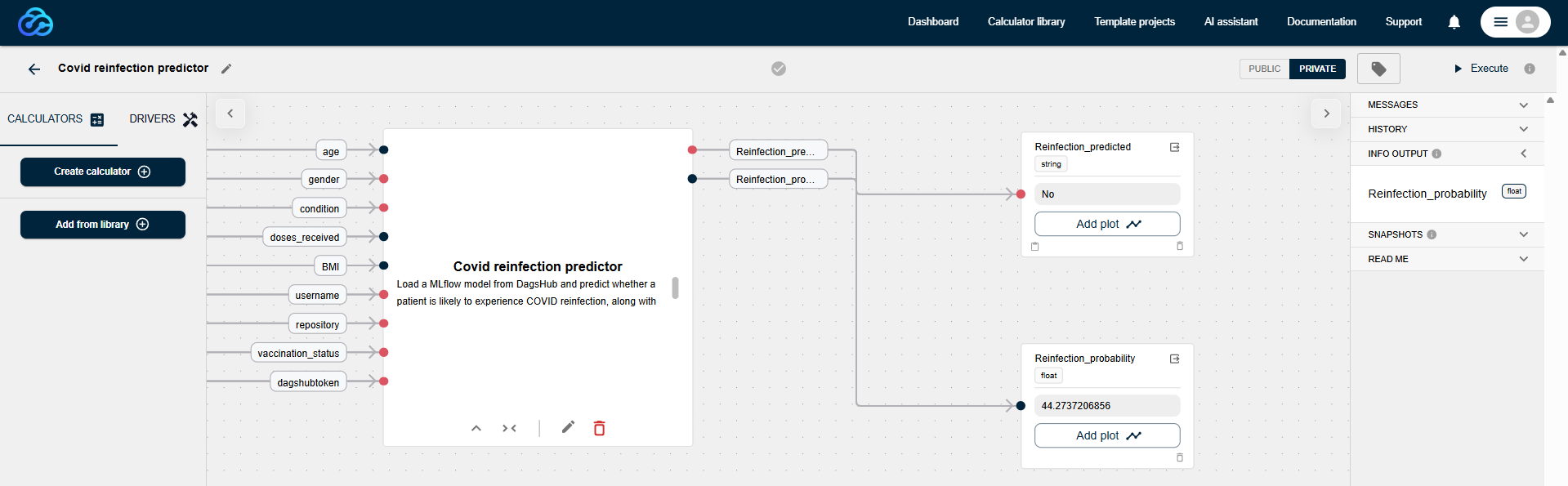
Let's walk through a real example. Below is a COVID-19 reinfection predictor - a machine learning model trained to assess reinfection probability based on patient characteristics:
python

import mlflow
import mlflow.sklearn
import pandas as pd

# Load versioned model from MLflow/DagsHub
model_name = "CovidReinfectionPredictor"
model_uri = f"models:/{model_name}/latest"
model = mlflow.sklearn.load_model(model_uri)

# Define patient case
example_case = pd.DataFrame([{
    "Age": 60.0,
    "Gender": "Male",
    "Preexisting_Condition": "Diabetes",
    "Vaccination_Status": "Partially Vaccinated",
    "Doses_Received": 1.0,
    "BMI": 29.0
}])

# Predict
prediction = model.predict(example_case)[0]
probability = model.predict_proba(example_case)[0][1]
print("Reinfection Prediction:", "Yes" if prediction == 1 else "No")
print("Probability:", f"{probability*100:.2f}%")
This works perfectly for a data scientist with Python installed, access to MLflow, knowledge of the model's input schema and with understanding of the prediction output. But what about the physician who wants to use this during patient consultations? The epidemiologist who needs to run it on hundreds of patient records? Or the department head looking into a scalable workflow?
The engicloud.ai Solution
1. Run Locally Trained ML Models on a Graphical Canvas
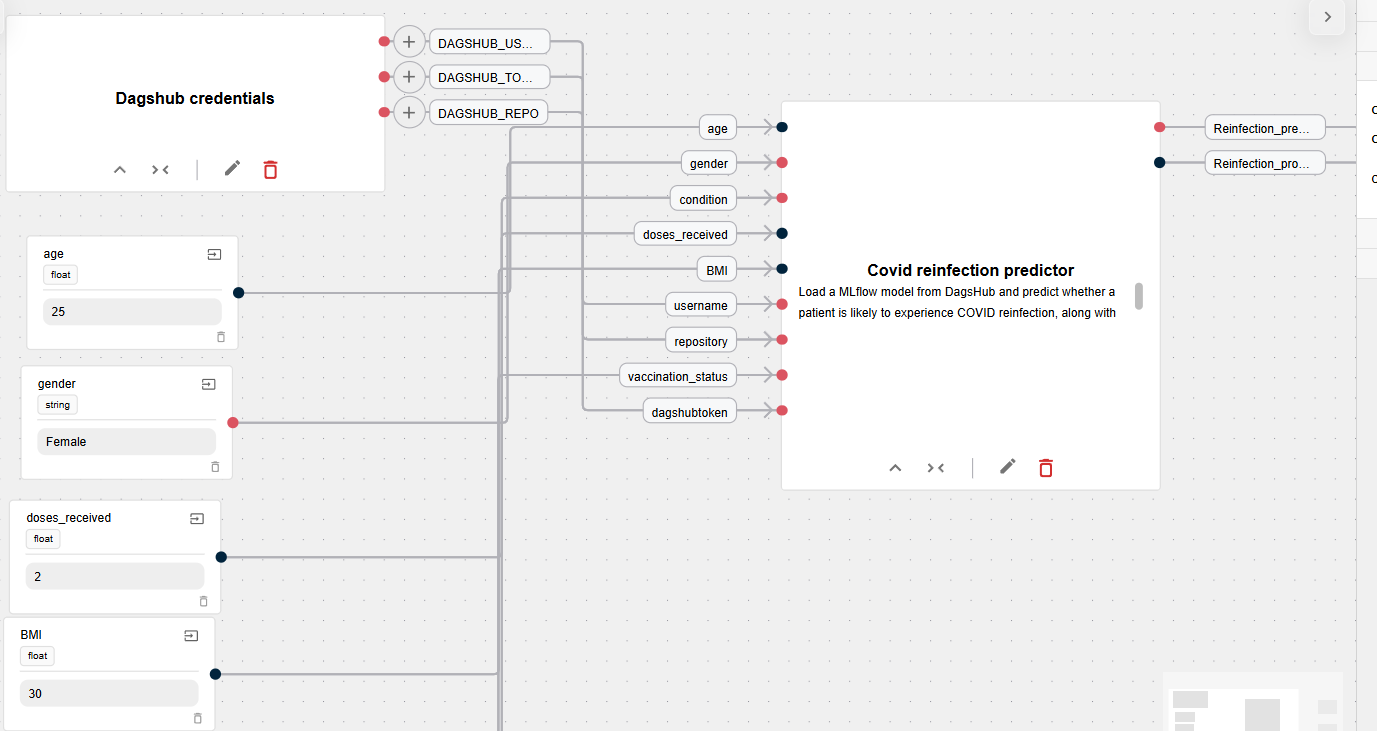
With engicloud.ai, you don't rewrite your model. You wrap it. The code above becomes a "Calculator" - a reusable, documented Python module with clearly defined inputs and outputs. Once uploaded, anyone can drag it onto engicloud.ai's graphical canvas, define input parameters in the automatically created fields such as Age, Gender, Preexisting Condition, Vaccination Status, Doses Received, BMI and run the calculation without ever seeing a line of code.
A physician can now run a reinfection prediction in 30 seconds, without ever seeing a line of code.
2. Program Backend Logic for Non-Coders
This is the breakthrough moment for collaboration. Your data science team builds the backend - the validated models, the preprocessing logic, the prediction pipelines. But they don't have to build the frontend, the deployment infrastructure, or the user training materials.
engicloud.ai's canvas is the frontend. It adapts to whatever logic you program:
- Chain models: Connect multiple models on a single canvas
- Conditional logic: Program triggers like "If probability > 70%, route to specialist review queue"
- Data transformations: Normalization, encoding, aggregation all in the canvas
Your computational team owns the science. Your domain experts own the decisions. The canvas is the bridge.
3. Curate Secure, Proprietary Analytic Toolkits
Not every model should be public. Many organizations have proprietary algorithms, competitive analysis tools or regulated medical/financial models.
engicloud.ai lets you build private toolkits - curated collections of calculators and projects that stay within your organization's boundary.
For our COVID predictor example:
- The model stays versioned in your MLOps tool (here MLflow).
- The engicloud.ai wrapper lives in your private workspace.
- Only invited team members can access it.
- Audit logs track every use.
You control what's shared, who can edit, and how it evolves.
4. Unite Diverse Departments in Joint Computational Efforts
This is where engicloud.ai becomes transformative for large organizations.
Consider a hospital system that consists of ...
- a research department that develops new predictive models,
- a clinical department that uses models for patient care,
- an IT department that manages data access and security.
- and a compliance department that validates model governance.
In such a traditional setup research builds a model, delivers to IT. IT builds an interface that is reviewed by the compliance department. Finally, the clinical department gets access 6 months later.
With engicloud.ai the workflow looks as following:
- The research department wraps the model in engicloud and shares it with the clinical department via the canvas.
- IT department manages access permissions centrally.
- Compliance department can review the model logic directly in engicloud.
- Everyone sees the same versioned, documented tool.
The time from model to deployment reduces from months to weeks.
A New Paradigm for ML Operations
The MLflow example above represents the current state of the art: beautifully versioned, properly tracked, scientifically sound models. That's the hard part, and tools like MLflow solve it well.
What hasn't been solved, until now, is the "last mile", namely getting those models into actual use without reinventing the wheel every time.
engicloud.ai provides that missing layer:
Getting Started
If you're already using MLflow, DagsHub, or similar MLOps tools, you're halfway there. Your models are ready, now they need an interface.
Start with a copy of the curated project on the platform, watch the walkthrough tutorial and dive right into the next steps:
- Explore the canvas: See how existing calculators are structured
- Wrap your first model: Turn your Python code into a reusable component
- Invite your team: Let your domain experts test your model on the graphical interface
The Bottom Line
engicloud.ai transforms your ML models from repository artifacts into operational tools, accessible to everyone who needs them, without requiring everyone to become a Python developer.
The best model isn't the most sophisticated one. It's the one that actually gets used.