
How engicloud.ai Empowers Engineers and Researchers to Build, Share, and Extend Photovoltaic Modeling Workflows
The Challenge: From Code to Collaborative Science
Every engineer or researcher in renewable energy knows the scenario. You’ve found an excellent Python package like pvlib - a well-documented, community-maintained library for photovoltaic system modeling that represents decades of validated solar knowledge.
The physics is sound. The functions are tested. The documentation is thorough. But then comes the harder part.
- How do you turn this library into a reusable workflow that partners, customers, or colleagues can build upon?
- How do you ensure that when a colleague leaves, their carefully constructed models don’t leave with them?
- How do you share your work with collaborators who may not be Python experts - or who simply want to run the model without debugging import errors?
This is where engicloud.ai transforms modeling workflows.
A Real Example: Solar PV System Modeling
Let’s walk through a concrete example. A research team wants to model a complete photovoltaic system from solar irradiance hitting the panels, through power generation and all the way to battery storage sizing. Using pvlib and NumPy, they’ve written the physics.
Here is how the components break down in standard Python:
1. Solar Irradiance Calculator
This calculates plane-of-array irradiance based on location, time, and panel orientation.
2. Load Profile Calculator
A time-varying electrical load representing household consumption (lower at night, higher in the evening).
3. Panel Power Calculator
Converts irradianceinto DC and AC power, based on panel efficiency, area, number of panels, andsystem losses.
4. Battery Sizing Calculator
Analyzes the net powerflow to determine the required battery capacity and nominal storage size forself-sufficiency.
Each piece is straightforward Python. Together, they form a complete PV system model.
engicloud.ai Calculators & Projects: Encapsulating Expertise
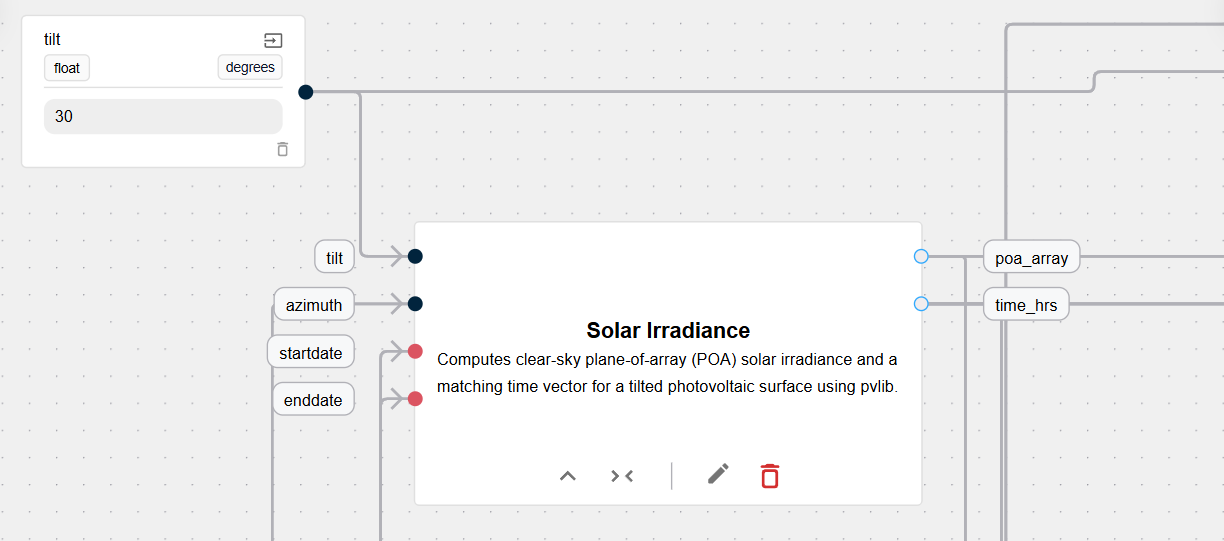
In engicloud.ai, you don't have to rewrite your existing code. Instead, each of these code blocks becomes a Calculator—a self-contained, reusable Python model withclearly defined inputs and outputs:
The key insight: The underlying Python code does not change. pvlib remains your computational engine, but now each piece is:
- Discoverable: Searchable in the platform
- Documented: Inputs, outputs, and physics are explicit
- Reusable: Drag and drop into any new project
- Shareable: Publish to your team or the entire scientific community
Users can directly write their own custom calculators, or tap into our massive library of curated, human-validated models and sophisticated LLM-generated calculators.
Chaining Calculators into Workflows
engicloud.ai’s Project feature allows researchers to chain calculators together visually on a graphical canvas:
The connections are explicit. A new team member can immediately see what data flows where, which physical assumptions are made, and where to adjust parameters for sensitivity studies:

The Platform Benefits
1. Knowledge Retention & Reproducibility
"Co-workers orstudents leave - and take knowledge with them." It's a frustrating reality in engineering. With engicloud, models are stored centrally on the platform, visually documented, and easy to fork. When you share a Project, collaborators get the entire computational environment - meaning perfect environment consistency, input clarity, and workflow transparency.
2. Building on Expert Work & Collaboration
pvlib is maintained by photovoltaic experts at Sandia National Laboratories and the broader open-source community. It represents decades of validated solar modeling knowledge. engicloud.ai doesn’t replace pvlib's community-validated physics; it amplifies it. Python experts build the calculators, domain experts assemble the workflows, and non-technical stakeholders can explore results without touching a single line of code.
3. The "Paper to Equation" Revolution
Tired of "code available upon request"? With engicloud.ai's Paper to Equation tool (available on our Pro tier), you can convert any scientific publication directly into a runnable workflow. You can execute this for any arbitrary publication, but you can also publish your Project alongside your paper, allowing readers to execute your model immediately with their own data. This is what living papers should look like.
From Research to Dissemination
Traditional Academic Workflow
- Write paper
- Add “code available upon request” or a GitHub link
- Hope someone can reproduce it
- Watch citations — but nobody actually runs the model
engicloud.ai Workflow
- Build the model as interconnected Calculators
- Publish the Project alongside the paper
- Readers run the model immediately with their own data
- Extensions are traceable, forkable, and citeable
This is what living papers should look like.
Technical Integration: Leveraging the Python Ecosystem
“Do I have to rewrite everything?” No:
engicloud.ai runs your code with access to:
- NumPy / SciPy for numerical computing
- pandas for time-series handling
- Domain libraries like pvlib, CoolProp, or internal packages
The platform adds structure — not constraints.
What engicloud Adds
A Researcher’s Timeline with engicloud.ai
- Week 1: Import existing
pvlibcode into Calculators. Define inputs (location, dates, panel specs) and outputs (power curves, battery size). - Week 2: Build a Project. Run sensitivity studies. Collaborators in Germany run the same model with different locations.
- Month 2: A new student joins. Instead of “here’s a notebook, good luck,” they explore the Project visually and understand it in an afternoon.
- Month 6: Paper accepted. The Project is published with the manuscript. Three research groups cite it - and extend it.
- Year 2: The student graduates. The model lives on.
Conclusion: The Platform for Living Engineering Knowledge
engicloud.ai doesn’t replace Python, pvlib, or deep domain expertise. It makes that expertise easier to access, reuse, extend, and collaborate on. In the age of AI, scientific and engineering knowledge must remain executable, not just described.
For researchers: less time fighting environments. For teams: knowledge that survives personnel changes. For science: work that can actually be reproduced.
Try it out
Try the solar panel and battery system project directly on the platform or watch the walk-through tutorial.
That’s the promise of engicloud.ai — where 20,000 equations define your next discovery.
Ready to transform your research workflow?
Explore engicloud.ai and turn your existing Python models into collaborative, reusable engineering knowledge.