
How to Navigate ~20,000 Engineering Models with Semantic Search

How to Navigate ~20,000 Engineering Models with Semantic Search
In our previous article we described how we built a library of ~20,000 engineering models. However, a library of 20,000 models is only useful if you can find the right one when you need it.
Keyword search can easily fail in this setting. Engineers do not always know what an equation is called. You might know you need "something to calculate pressure drop through a packed bed" without knowing that what you are looking for is the Ergun equation. Or you might search for "heat transfer coefficient in turbulent pipe flow" and miss the Dittus-Boelter correlation entirely — because it is known by a different name.
This article explains how semantic search in Engicloud solves this — and how to get the most out of it.
The Problem with Keyword Search
Keyword search on 20,000 models has three failure modes:
- Vocabulary mismatch: you use different words than the model author did
- Concept fragmentation: the same physical concept appears under different names in different engineering subfields
- Too many results: a broad term like "efficiency" matches hundreds of models with no ranking by relevance
Semantic search addresses all three. Instead of matching strings, it matches meaning so you can describe your problem in plain language and find the right model even when you don't know its name.
Five Ways to Search
Not every search starts from the same place. Sometimes you know the name of what you're looking for. Sometimes you just know the problem you're trying to solve.
Each model can be searched across five angles:
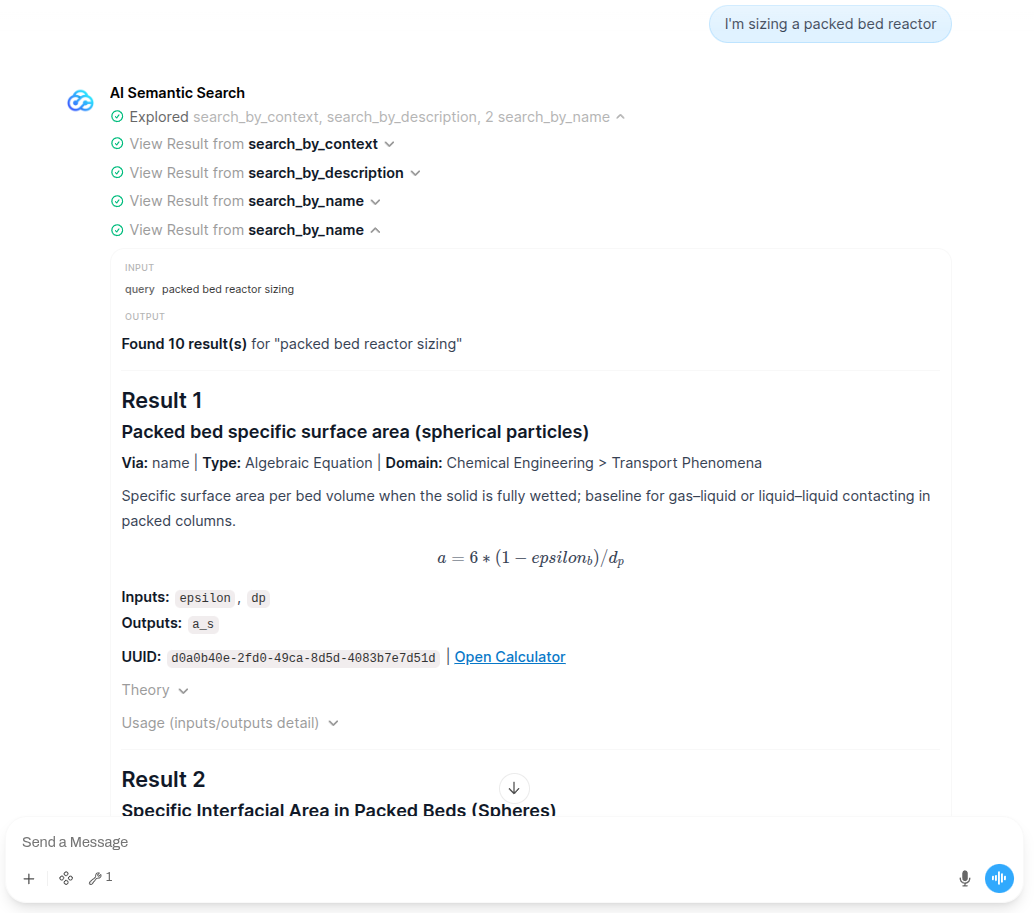
- Name - for when you already know what the model is called
- Description - for when you know what output you need but not which model produces it
- Context - for when you're exploring a problem and want to know what tools are available
- Theory - for when you're working from a textbook or first principles
- Usage - for when you want to know if a model fits your specific situation before committing to it
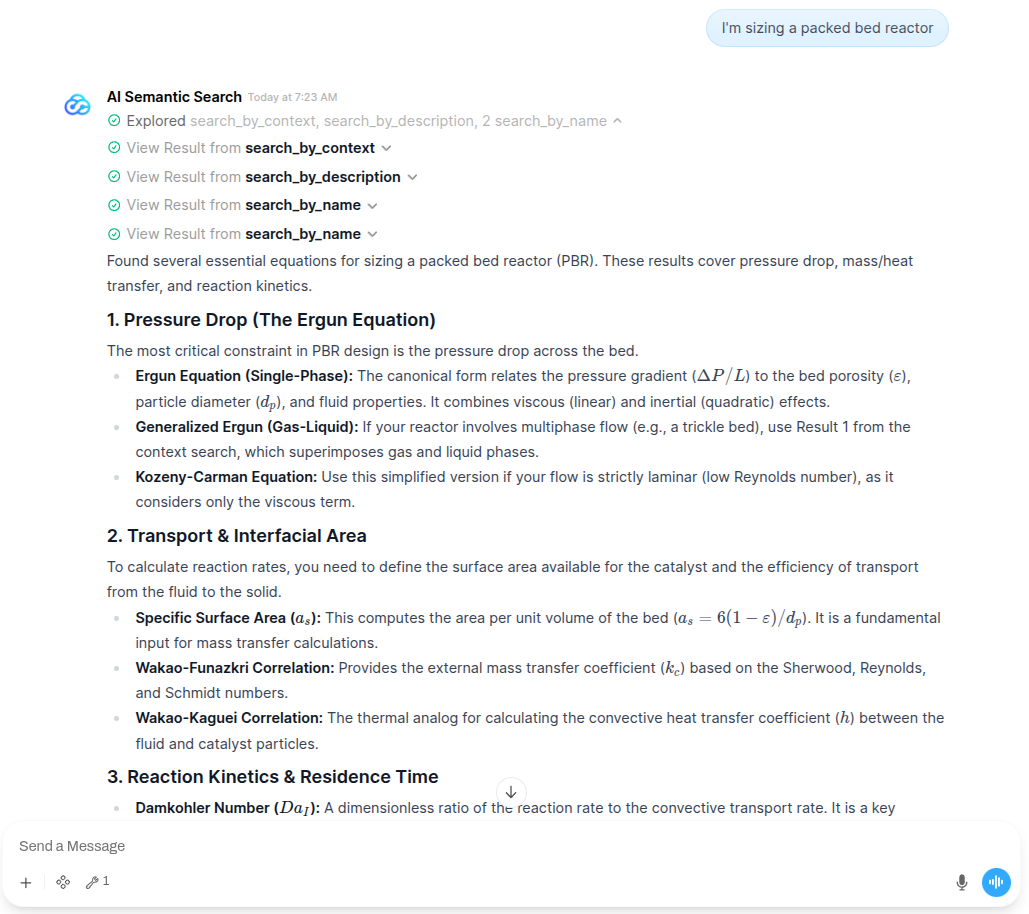
You do not need to pick one — the search automatically focuses on the most relevant ones based on your query. So "I'm sizing a packed bed reactor", "early-stage heat exchanger sizing", and "conservation of momentum in compressible flow" are all valid searches, each landing on the models most relevant to that particular angle.
Why This Works in Practice
Semantic search is only useful if the models it surfaces are trustworthy and self-describing. Every model in our library is built with that in mind:
- Explicit inputs and outputs - you know exactly what a model needs and what it returns, so you can connect models together without guesswork
- Rich documentation - context and usage sections tell you whether the model's assumptions match your situation before you run it
- Domain coverage - models are organised across 20 engineering fields and 110 subfields, so results can be narrowed to your specific area when needed
Together this means you can go from a plain-language description of your problem to a running, documented calculation — without hunting through textbooks or re-implementing equations from scratch.
Try It
Semantic search is available directly in the engicloud.ai. Type a description of your problem in plain language, you do not need to know the name of the model you are looking for. If it exists in the library, you will find it.

About the author
Dr. Daniel Louw holds a Phd in Mechanical Engineering from Stellenbosch University (South Africa) and has previously worked as a Post-Doc researcher at the group of Prof. Peters at University of Luxemburg, focusing on Multi-phase Modeling of Industrial Biomass Combustion.
He is currently a consultant and software developer at DCS Computing and contributed significantly to for the engicloud.ai calculator library.